Stop Shrinking: How to Re-Architect Your Posture for Confidence & Power
Table of contents
Look around a coffee shop. What do you see?
You see brilliant, capable women collapsed over glowing screens. Shoulders rounded forward in protection, heads down in submission, lungs compressed.
We are facing a “Shrinking Epidemic.”
Between the social conditioning to “be small” and quiet, and the physical conditioning of our technology, we have adopted the posture of prey. We are shrinking our physical footprint, and in doing so, we are shrinking our psychological presence.
We believe it is time to stop fixing our posture just to “look nice” in a dress. We are re-architecting our bodies to handle more life, more stress, and more power.
The Science: Your Body Tells Your Brain How to Feel
We tend to think our mind controls our body. But the reverse is scientifically true: Your body tells your brain who you are.
This biological feedback loop is powerful, but it is often disrupted by habits we don’t even notice. The way we sit, stand, and even look at our phones creates deep muscular imbalances that “lock” us into a passive state. We dive into the mechanics of these habits in our guide: It’s Not How You Sit: The Real Reason Your Posture Is Suffering.
This is called Embodied Cognition. When you slouch, your chest collapses and your breathing becomes shallow. Your brain reads this physical state as “danger” or “weakness” and releases Cortisol (the stress hormone). You actually become more anxious because of how you are standing.
Conversely, research popularized by social psychologists at Harvard University suggests that “high-power poses”—open, expansive postures—can stimulate a physiological shift. By taking up space, you signal safety and dominance to your nervous system, potentially raising testosterone (confidence) and lowering cortisol.
You don’t just stand taller because you are confident; you become confident because you stand tall.
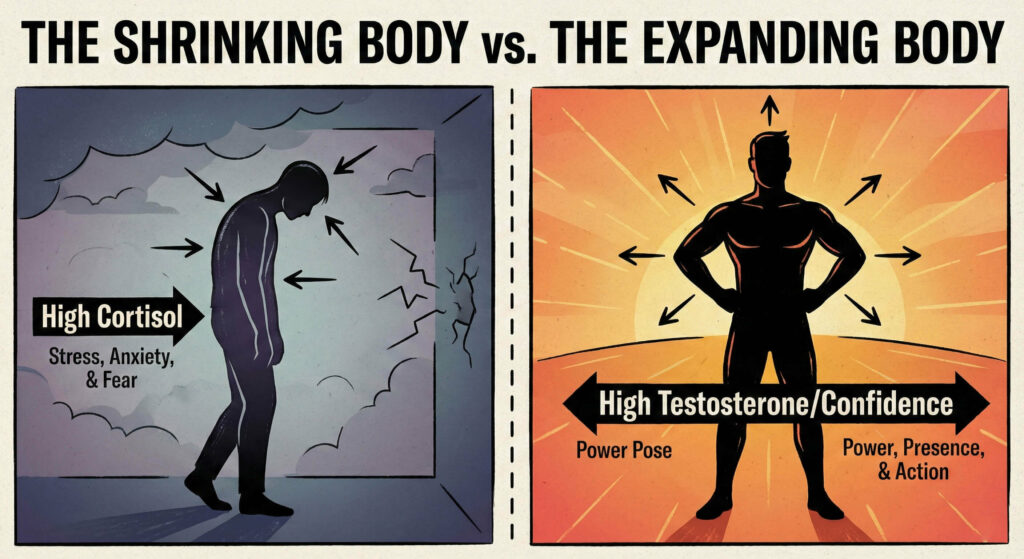
Comparison: The Passive Body vs. The Architected Body
We are moving from a body shaped by gravity and screens to a body built by intention. Here is the difference in how you operate:
While conscious movement is the goal, the environment you sit in for eight hours a day plays a massive role in this reconstruction. If you find it impossible to maintain this “architected” structure in a standard office seat, we tested alternative seating options designed to force alignment in our review: Kneeling Chair vs. Yoga Ball: Which “Weird” Chair Actually Fixes Posture?
| Feature | The Passive Body (Shrinking) | The Architected Body (Expanding) |
| Physical Shape | Rounded shoulders, forward head. | Open chest, stacked spine. |
| Hormonal State | High Cortisol (Stress/Fear). | Balanced/High Testosterone (Confidence). |
| Breathing | Shallow (Apical breathing). | Deep, full diaphragmatic breaths. |
| Mental State | “I hope I don’t mess up.” | “I can handle this.” |
| Signal to World | Submission / Fatigue. | Authority / Vitality. |
The 3 Pillars of Re-Architecting
You are the architect. You can rebuild your frame today using these three structural pillars.
Pillar 1: The Foundation (Un-tuck the Pelvis)
Many women chronically tuck their tailbone (clenching the glutes) or sway their back. Both are weak positions.
The Fix: Find “Neutral.” Imagine your pelvis is a bowl of water. Don’t spill it forward or backward. Let your glutes relax so your spine has a solid base.
Pillar 2: The Heart (Open the Chest)
We round our shoulders to protect our hearts—literally and metaphorically.
The Fix: Imagine you are wearing a necklace with a heavy diamond pendant. Lift your sternum so the diamond catches the light. This moves you from “protection mode” to “connection mode.”
Pillar 3: The Crown (The Head Ramp)
“Tech Neck” adds 60 pounds of pressure to your spine.
The Fix: Don’t just lift your chin. Slide your entire head back horizontally, as if you are ramping it up against a wall behind you. Your ears should be stacked directly over your shoulders.

This is a Daily Practice
Re-architecting isn’t a one-time surgery. It is a decision you make 100 times a day.
Every time you catch yourself shrinking in a meeting, expand.
Every time you catch yourself hunching over your phone, stack your spine.
You are building a vessel that is harder to knock down.
Check your posture right now.
Are you shrinking or stacking? Take a deep breath, roll your shoulders back, and tell us how you feel in the comments below.