Scalp Psoriasis vs. Dandruff: The Critical Differences You Might Be Missing
Table of contents
The Misdiagnosis Trap: Why Your Shampoo Isn’t Working
If you have been struggling with a flaky, itchy scalp and your standard anti-dandruff shampoo hasn’t provided relief, you might not be dealing with dandruff at all. Many people fall into the trap of over-washing and aggressively scrubbing their scalp, thinking they are fighting a fungal issue, when they are actually suffering from an autoimmune condition.
Treating Scalp Psoriasis as if it were simple dandruff is one of the fastest ways to damage your Skin Barrier. While the symptoms—flakes and itching—overlap, the biological mechanisms are entirely different. One requires managing a fungus, while the other requires calming an overactive immune response. To achieve true Scalp Health, you must first identify which condition is living at your roots.

Dandruff vs. Scalp Psoriasis: The Comparison Table
Use this diagnostic breakdown to identify the specific characteristics of your scalp condition.
| Feature | Dandruff (Seborrheic Dermatitis) | Scalp Psoriasis |
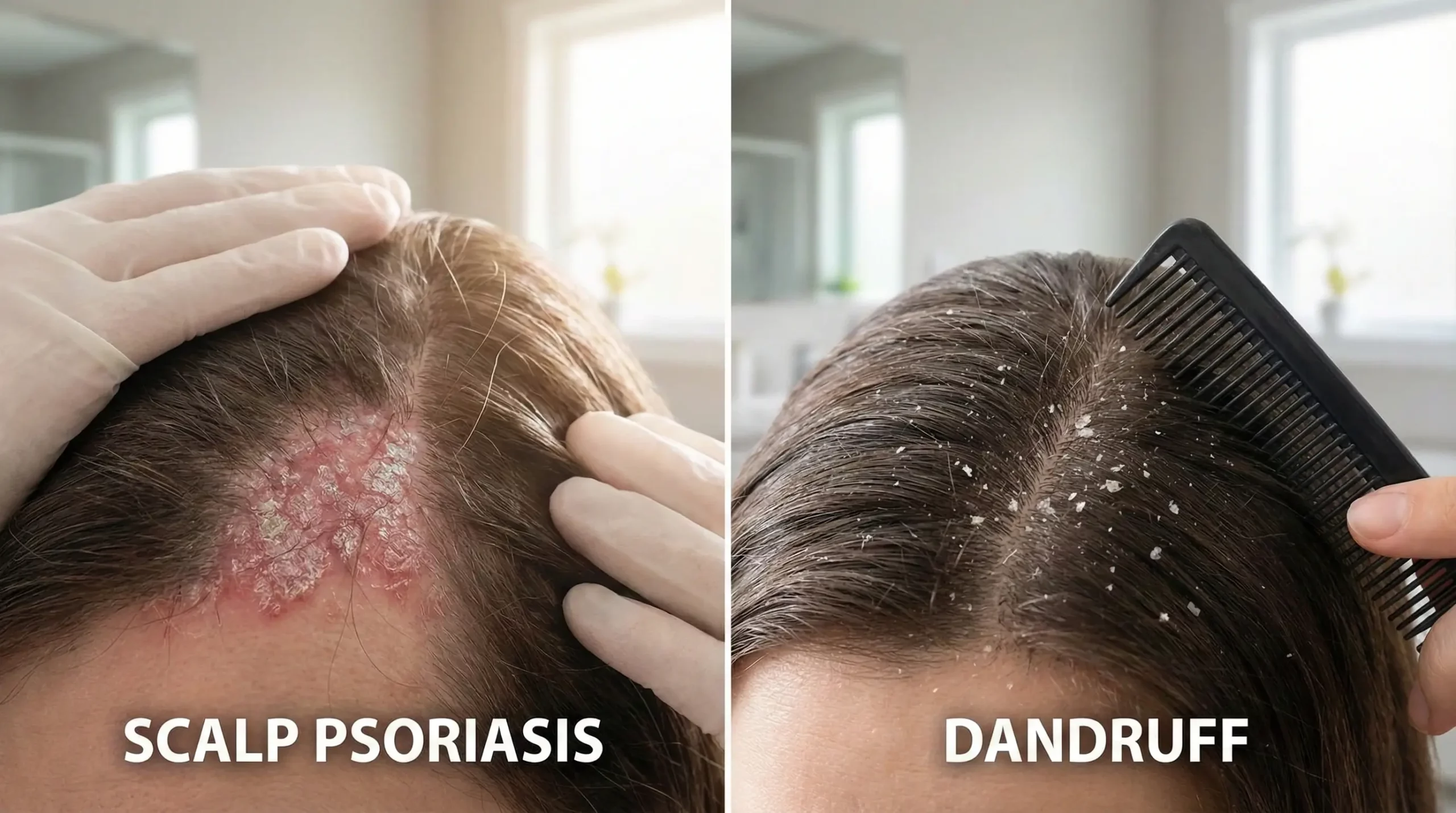
| Flake Color | Yellowish or white. | Silvery-white or “micaceous” scales. |
| Texture | Oily, waxy, and often sticky. | Dry, thick, and powdery plaques. |
| Scalp Appearance | Pinkish or red, often oily. | Red, well-defined, and raised patches. |
| Coverage Area | Limited to the scalp and eyebrows. | Often extends to the forehead, ears, or neck. |
| Sensation | Itchy, but rarely painful. | Itchy, burning, or “tight” soreness. |
| Root Cause | Fungal overgrowth (Malassezia). | Autoimmune-driven cell turnover. |
Defining the Biological Root Causes
1. Dandruff: The Fungal Micro-Environment
Dandruff is primarily caused by an overgrowth of a yeast-like fungus called Malassezia. This fungus feeds on the natural oils produced by your follicles. When the fungus flourishes, it irritates the skin, causing cells to shed more rapidly than normal. You can learn more about managing the hidden fungus on your scalp to restore balance to your microbiome.
2. Scalp Psoriasis: The Autoimmune Acceleration
Psoriasis is not caused by fungus or poor hygiene. It is an autoimmune condition where the immune system sends faulty signals that tell skin cells to grow too fast. Instead of shedding in weeks, the cells pile up in days, creating thick, red patches covered in silvery scales. Because this is a systemic issue, it is often influenced by internal factors like Cortisol and inflammation.
Visual Diagnostic: Color, Texture, and Borders
When examining your scalp, look for these “red flags” that point toward psoriasis:
- The Silver Sheen: Psoriasis scales often have a distinct silvery or metallic sheen, especially when dry. Dandruff flakes are usually matte and yellowish.
- Defining the Borders: Psoriasis patches have very clear, sharp borders. You can tell exactly where the patch ends and the healthy skin begins. Dandruff is typically more diffuse and spread out.
- Bleeding Points: If you pick at a psoriasis scale, it may cause pinpoint bleeding (known as the Auspitz sign). This does not happen with standard dandruff and is a clear sign that your Skin Barrier is compromised.
Targeted Treatment Strategies
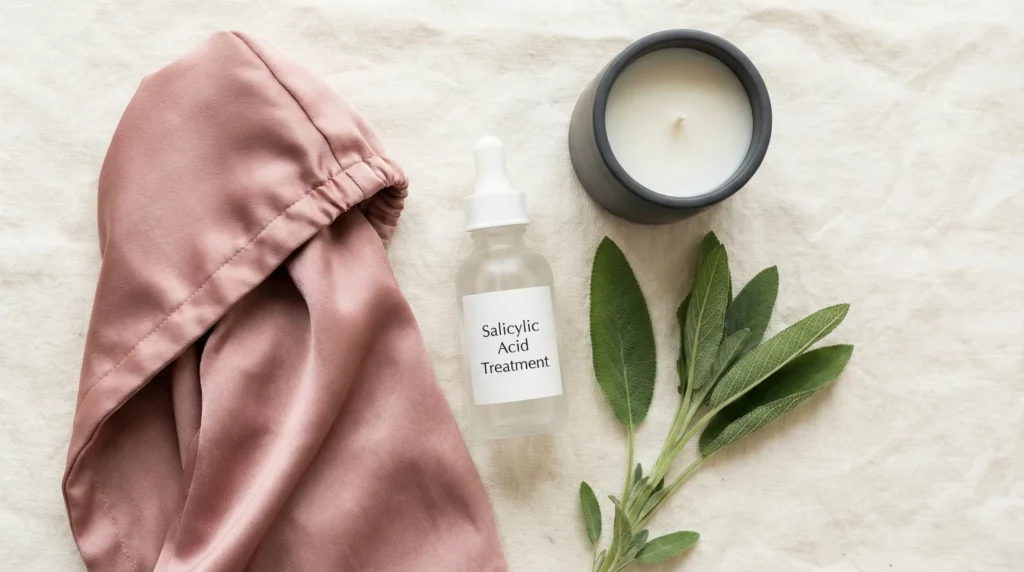
Choosing the right active ingredients is critical. Using a harsh antifungal on a psoriasis-prone scalp can cause a massive flare-up.
- For Dandruff: Focus on Salicylic Acid to dissolve oily flakes and Zinc Pyrithione to target the yeast.
- For Psoriasis: You need a high-quality Moisturizer or “keratolytic” to soften the plaques. Coal tar and topical steroids (prescribed by a professional) are often necessary to slow down the cell production.
- The Minimal Routine: Regardless of the condition, a Minimal Routine that avoids sulfates and synthetic fragrances is essential for recovery. Aggressive scrubbing will only increase inflammation.
The Stress Connection
Both conditions are heavily impacted by your internal state. High levels of Cortisol—the primary stress hormone—can trigger a psoriasis flare or make a dandruff-prone Oily Scalp significantly worse. Maintaining systemic health, such as identifying the difference between night waking and insomnia, helps keep your immune system stable and your skin calm.
According to the American Academy of Dermatology (AAD), early intervention is key to preventing hair thinning that can occur when thick psoriasis plaques block the hair follicle’s path.
Conclusion: Correct Identification for Clear Results
Treating your scalp without a proper diagnosis is like trying to fix a car without knowing which part is broken. If your “dandruff” is silvery, thick, or extends past your hairline, it is time to shift your strategy toward psoriasis management. By respecting your Skin Barrier and choosing targeted treatments, you can achieve a clear, healthy scalp and stronger hair.
Have you ever used a product that made your scalp worse instead of better? Did you find the silvery scale check helpful? Let’s talk about your experience in the comments below!
If you’ve found a routine that works for your psoriasis or dandruff, share your journey with us using #sylvaia_com on social media!