Progesterone vs. Oily Skin: The Real Reason Your T-Zone Goes Wild in Weeks 3–4.
Table of contents
The Luteal Flare: Why Your Skin Shifts Gears
If you have ever noticed that your skin remains clear and cooperative for two weeks, only to become a “grease factory” overnight, you aren’t imagining things. This sudden shift is a hallmark of the Luteal Phase—the final 14 days of your cycle. During this window, your body prioritizes the thickening of the uterine lining, a process driven by a massive surge in the hormone Progesterone.
While Progesterone is essential for reproductive health, it has a secondary, often frustrating effect on your complexion. It causes your pores to compress while simultaneously signaling your sebaceous glands to ramp up production. This combination traps oil beneath the surface, leading to the “wild” T-zone and the deep, painful blemishes associated with Hormonal Skin After 30. Understanding this biological shift is the key to mastering your Cycle Syncing for Skincare and Health routine.
Follicular Glow vs. Luteal Grease: The Comparison Table
The behavior of your T-zone is a direct reflection of the shifting ratio between Estrogen and Progesterone.
| Feature | Follicular Phase (Weeks 1-2) | Luteal Phase (Weeks 3-4) |
| Primary Hormone | Estrogen (The “Glow” hormone). | Progesterone (The “Oil” hormone). |
| Pore Status | Open and clear. | Compressed and easily clogged. |
| Oil Consistency | Thin and easily dispersed. | Thick, waxy, and stagnant. |
| Skin Sensitivity | Lower; high resilience. | Higher; prone to inflammation. |
| Main Concern | Maintaining hydration. | Managing congestion and shine. |
The “Greenhouse Effect” in Your Pores
Why does your skin feel specifically oily and congested during these two weeks? Progesterone causes the skin to swell slightly, which puts pressure on the openings of your pores. This “compresses” the pore, making it harder for sebum to flow out naturally.
At the same time, your levels of Testosterone (which stay relatively stable) now have more influence because Estrogen is no longer high enough to mask them. This “relative androgen dominance” triggers the production of thicker, stickier oil. When this waxy sebum meets a compressed pore, it creates the perfect environment for the Night Routines for Adult Acne struggles many women face.
According to a study published in the Journal of Clinical and Aesthetic Dermatology, nearly 63% of women report a significant increase in skin oiliness and acne flares during the premenstrual (Luteal) phase.
The Luteal Strategy: Managing the Shine
To keep your T-zone under control without stripping your Skin Barrier, you must pivot your routine as you enter Week 3.
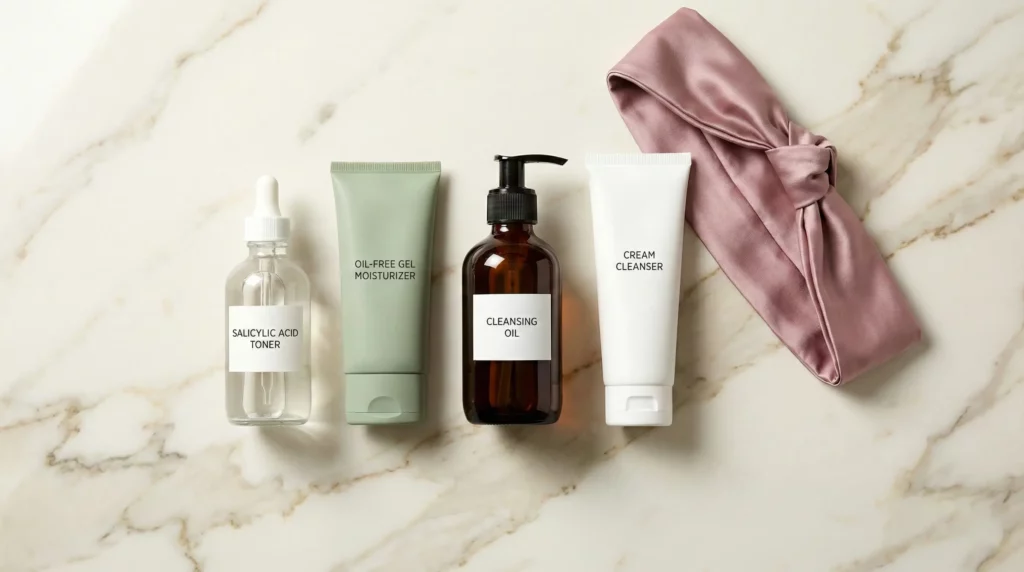
- Switch to Double Cleansing: Use a lightweight oil Cleanser to dissolve the thick, waxy sebum, followed by a water-based wash.
- Introduce Salicylic Acid: This BHA is oil-soluble, meaning it can penetrate the compressed pore to dissolve the clog from the inside out.
- Prioritize Oil-Free Hydration: Don’t skip the Moisturizer. If the skin becomes too dry, it will react by producing even more oil. Use a gel-based formula to keep the barrier intact.
- Control the Environment: Stress spikes Cortisol, which further stimulates oil production. Create a sanctuary with Dusty Rose and Sage Green tones to help your nervous system—and your skin—stay calm.
Expert Insight
“During the luteal phase, the rise in progesterone causes the skin to swell and the pores to tighten. This creates a ‘pressure cooker’ effect for sebum. It’s not about washing your face more; it’s about using oil-soluble ingredients like salicylic acid that can actually get inside the pore to clear out that thickened oil before it turns into a blemish.”
— Dr. Rebecca Marcus, Board-Certified Dermatologist and founder of Maei MD.
Conclusion: Mastering the Luteal Shift
Your T-zone doesn’t have to go “wild” every month. By recognizing that Weeks 3 and 4 require a different set of rules than the beginning of your cycle, you can maintain a clear, balanced complexion. Work with your biology by focusing on deep pore-clearing and barrier support.
Does your T-zone start acting up exactly 10 days before your period? What’s your go-to product for managing mid-day shine? Share your memories and tips in the comments below!
If you have a Luteal Phase routine that works, show us your “clearing kit” using #sylvaia_com on social media!