Yoga Ball vs Kneeling Chair: Which Is Better for Back Pain? (Tested)
Table of contents
Rachel, a 34-year-old copywriter, spent eight hours a day sitting. By 4:00 PM, her lower back felt like a brick.
She looked across the office and saw her coworker bouncing gently on a giant purple Yoga Ball. “That looks fun,” Rachel thought. “And it’s supposed to engage your core, right?”
Rachel ditched her ergonomic office chair and bought a ball. By Day 3, she was in more pain than ever.
Rachel’s assumption that her expensive ergonomic chair should have fixed the problem is a common one. But as we’ve explored before, the chair is often just one piece of a complex puzzle. We dive into the other factors in our guide: It’s Not How You Sit: The Real Reason Your Posture Is Suffering.
She realized that “Active Sitting” isn’t as simple as just swapping your seat. She decided to test the two most popular alternative chairs—the Yoga Ball and the Kneeling Chair—to see which one actually fixes the slouch.
The Science: Why 90-Degrees is the Enemy
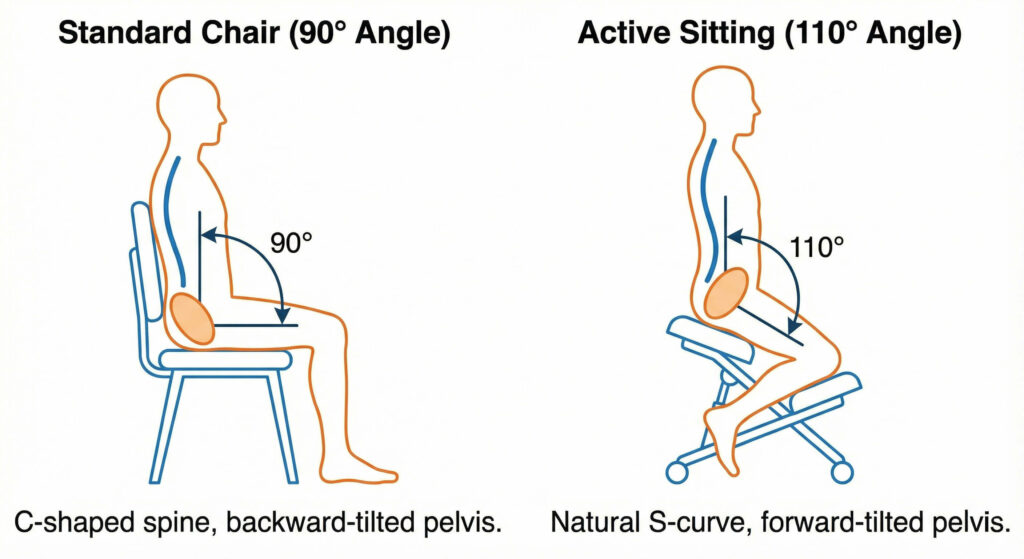
The problem with a standard office chair is the angle. It forces your hips into a 90-degree bend. This rotates your pelvis backward (tucking your tailbone), which flattens the natural curve of your lower spine.
Both the Yoga Ball and the Kneeling Chair aim to fix this by opening the hip angle to about 110 degrees. This restores the spine’s natural “S” curve.
However, according to a study cited by the Mayo Clinic, using a stability ball for prolonged periods does not significantly improve posture and can actually increase discomfort because of the lack of back support.
Comparison: The “Wobble” vs. The “Tilt”
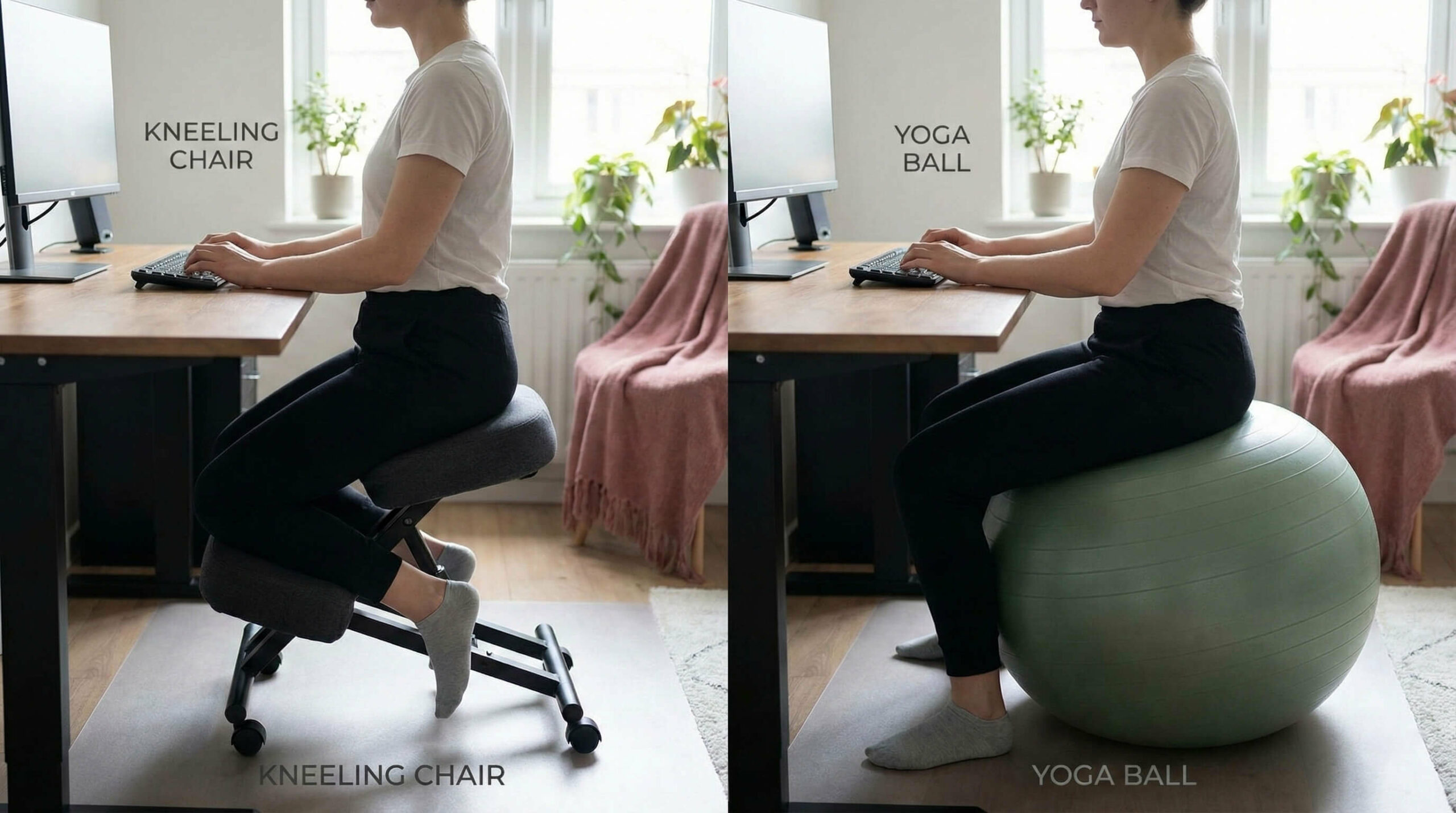
Rachel spent one week with each chair. Here is how they compared:
| Feature | The Yoga Ball (The Core Challenger) | The Kneeling Chair (The Spine Aligner) |
| Primary Mechanism | Instability. Forces muscles to fire to keep you upright. | Pelvic Tilt. Mechanically forces hips forward. |
| Core Engagement | High (Active). | Low (Passive). |
| Comfort Duration | 20-30 minutes max. | 1-2 hours. |
| The “Pain Point” | Lower back (due to muscle fatigue). | Shins and Knees (due to pressure). |
The Yoga Ball (The Core Challenger)
Rachel loved the ball for the first 20 minutes. She felt alert and active.
But here is the trap: Muscles get tired.
Because the ball has no back support, your core micro-muscles have to work 100% of the time. Once those muscles fatigue (usually after an hour), you inevitably collapse into a slouch that is even worse than in a normal chair. The “C-shape” slump puts massive pressure on the lumbar discs.
- Verdict: Great for a 20-minute “energy burst,” terrible for a full workday.
Rachel’s core collapsed because it wasn’t strong enough to maintain the position. This is common; we try to buy a solution when we really need to build one. If your core fatigues easily, a dedicated active routine might be the real answer. We’ve reviewed Ranking theTop 3 Online Yoga Classes That Actually Fix Tech Neck.
The Kneeling Chair (The Spine Aligner)
This chair looks like a torture device, but for Rachel’s back, it was a miracle.
Because the seat is tilted forward, it forces your pelvis to tilt open. You literally cannot slouch. Your spine stacks itself naturally without you having to “try” to sit up straight.
- The Downside: Gravity has to go somewhere. Instead of your butt taking the weight, your shins take it. After two hours, Rachel’s knees were throbbing.
- Verdict: Perfect for deep, focused work, but limited by knee comfort.
Rachel’s “Rotation” Rule

The experiment taught Rachel that there is no perfect chair. The human body isn’t designed to hold any single position for 8 hours.
Rachel found the cure in Rotation:
- Morning (9 AM – 11 AM): Kneeling Chair (for deep focus and perfect alignment).
- Mid-Day (11 AM – 3 PM): Standard Ergonomic Chair (to rest her shins and back).
- Afternoon Slump (3 PM – 4 PM): Yoga Ball (to wake up her brain and core).
Have you tried the “bouncing” chair?
Did you fall off, or did it save your back? Tell us your experience in the comments below!
Related article: