Week 4 Skin Dryness: The ‘Desert Phase’ & How to Fix It
Table of contents
The “Desert Phase”: Why Week 4 Feels Different
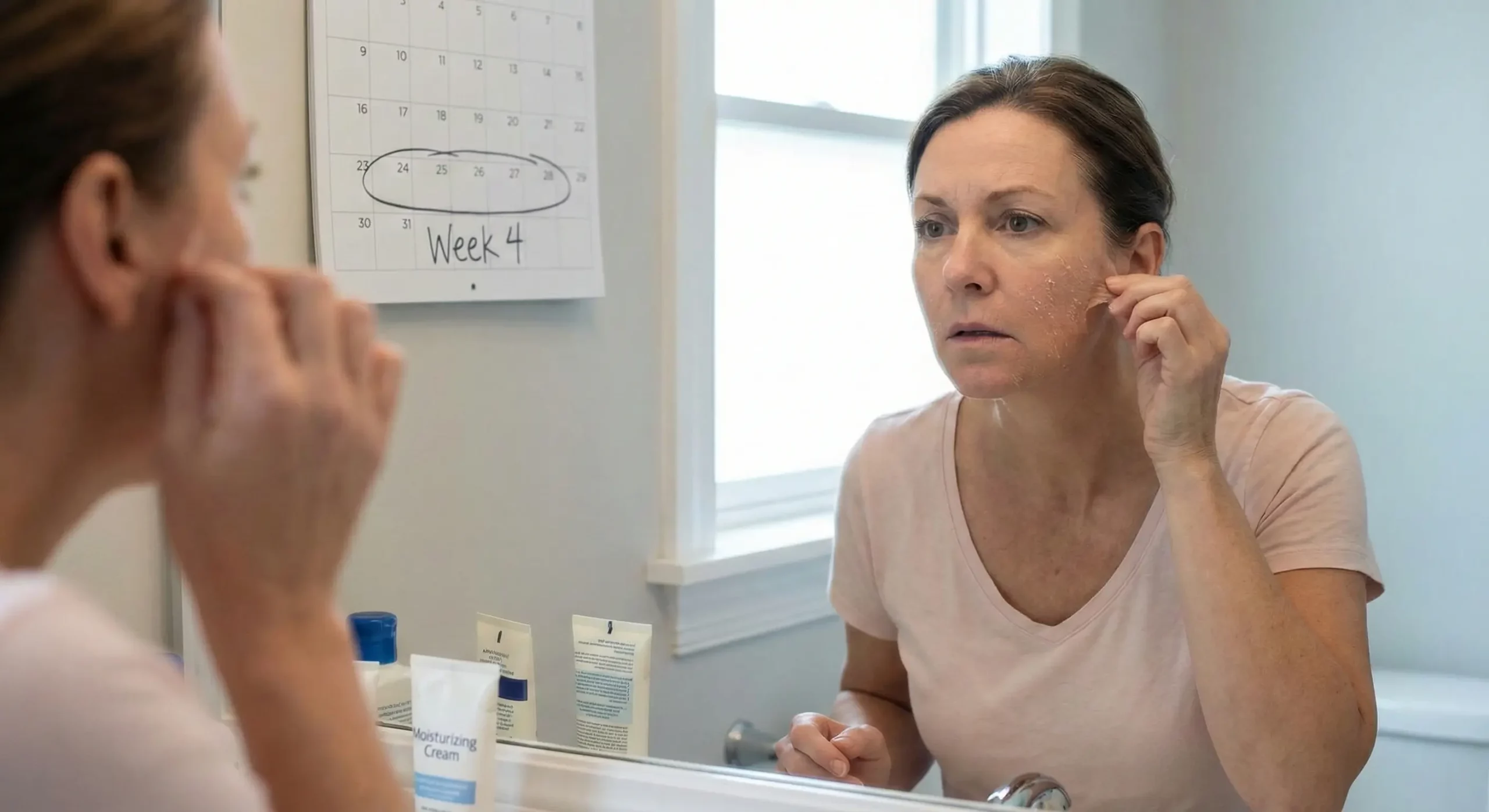
If you’ve ever reached for your favorite Moisturizer during the final days of your cycle only to find your skin remains tight, flaky, and dull, you aren’t alone. This isn’t a failure of your product; it’s a biological shift. In Week 4—the premenstrual or late Luteal phase—your levels of Estrogen and Progesterone plummet to their lowest points.
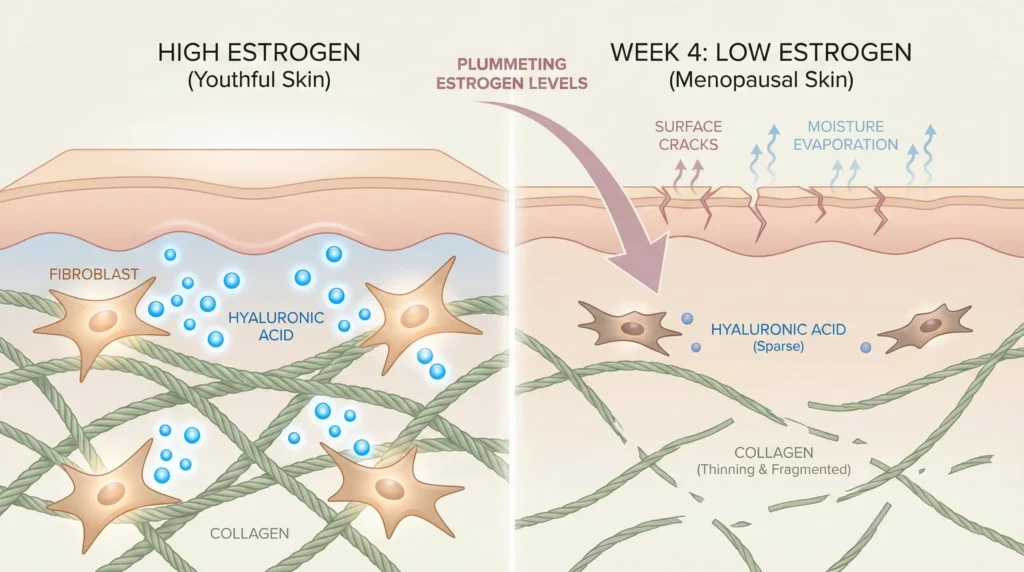
Estrogen is the unsung hero of a youthful glow. It stimulates the production of Collagen, elastin, and, most importantly, acid mucopolysaccharides (including Hyaluronic Acid) within the dermis. When Estrogen drops, your skin’s natural “water-holding” capacity vanishes. This leads to a compromised Skin Barrier, making your face feel like a desert regardless of how much cream you apply. Understanding the Hormonal Skin After 30 transition is key to surviving this recurring “desert phase.”
Estrogen High vs. Estrogen Low: The Hydration Table
Your skin’s ability to retain moisture is directly tied to the “hormonal weather” inside your body.
| Feature | Ovulation (High Estrogen) | Week 4 / Period Eve (Low Estrogen) |
| Water Retention | Maximum; skin looks plump and “glassy.” | Minimal; prone to Trans-epidermal Water Loss. |
| Barrier Strength | High; resistant to irritants. | Low; prone to redness and Sensitivity. |
| Texture | Smooth and reflective. | Rough, flaky, and “sallow.” |
| Natural Hyaluronic Acid | Peak production. | Drastic decline. |
| Moisturizer Efficacy | Absorbs and “locks” in easily. | Often “sits” on top of dry, dead cells. |
Why Your Cream is “Sitting” on Top of Your Skin
During Week 4, the drop in hormones slows down cell turnover. This causes dead skin cells to accumulate on the surface, creating an invisible, “crusty” layer. When you apply your cream, it can’t penetrate this barrier of dead cells to reach the thirsty layers beneath.
Additionally, because your body’s Cortisol levels often rise during the premenstrual window, your skin becomes more pro-inflammatory. This internal heat evaporates surface moisture faster than usual—a process known as Trans-epidermal Water Loss (TEWL). This is why your Night Routine needs to shift from “simple hydration” to “active barrier repair” during this specific week.
According to a study published in the International Journal of Women’s Dermatology, the decline in estrogen during the late luteal phase significantly impacts skin hydration and barrier function, leading to increased sensitivity and dryness.
The Week 4 “Moisture Rescue” Strategy
To fix the “Week 4 Dryness,” you must change how you hydrate, not just what you use.
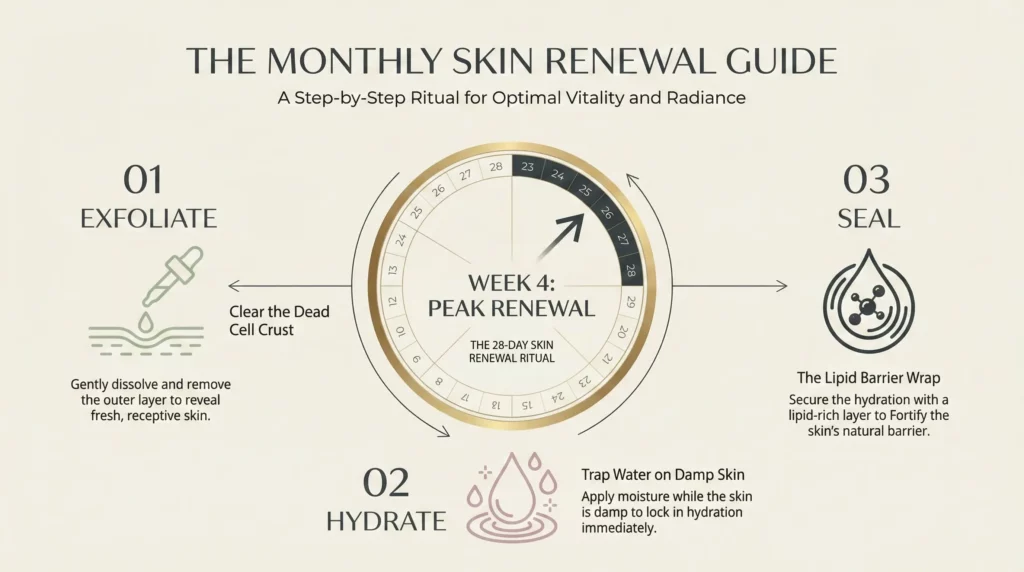
- Exfoliate to Open the Door: Use a very gentle enzyme or a low-percentage Lactic Acid twice this week. This removes the “dead cell crust” so your moisturizer can actually reach the skin.
- The “Damp Skin” Rule: Never apply moisturizer to dry skin during Week 4. Apply your Hyaluronic Acid serum and cream to skin that is still slightly wet from your Toner. This traps existing water into the barrier.
- Seal with a Lipid: Since your skin isn’t producing enough of its own oils (sebum) due to the estrogen drop, you must add them back. Layer a lightweight face oil over your moisturizer to act as a “plastic wrap” for your hydration.
- Lower the Heat: Hot water destroys a fragile skin barrier. Use lukewarm water for your Cleanser to prevent further dehydration.
Expert Insight
“During the premenstrual phase, the skin is at its most vulnerable. Estrogen is the hormone that keeps the skin thick and hydrated. When it drops, the skin literally becomes thinner and less able to hold onto water. It’s not that your moisturizer stopped working—it’s that your skin’s internal ‘sponge’ has shrunk. You have to provide the lipids and humectants that your body has temporarily stopped making.”
— Dr. Rebecca Marcus, Board-Certified Dermatologist and Hormonal Skincare Expert.
Conclusion: Adapting to the Estrogen Dip
Your skin isn’t being difficult; it’s being biological. By recognizing that Week 4 requires a more intensive, layered approach to hydration, you can bypass the flakiness and maintain your Deep Sleep glow even when your hormones are at their lowest. Treat your skin with extra kindness this week—it’s doing a lot of heavy lifting behind the scenes.
Do you find your skin feels ‘tight’ no matter how much you moisturize the week before your period? What’s your favorite ‘rescue’ product for dry patches? Share your memories and tips in the comments below!
Show us your “Week 4 Hydration Kit” using #sylvaia_com on social media!